Organic Marketing vs Paid Marketing: Which One Actually Grows Your Business?
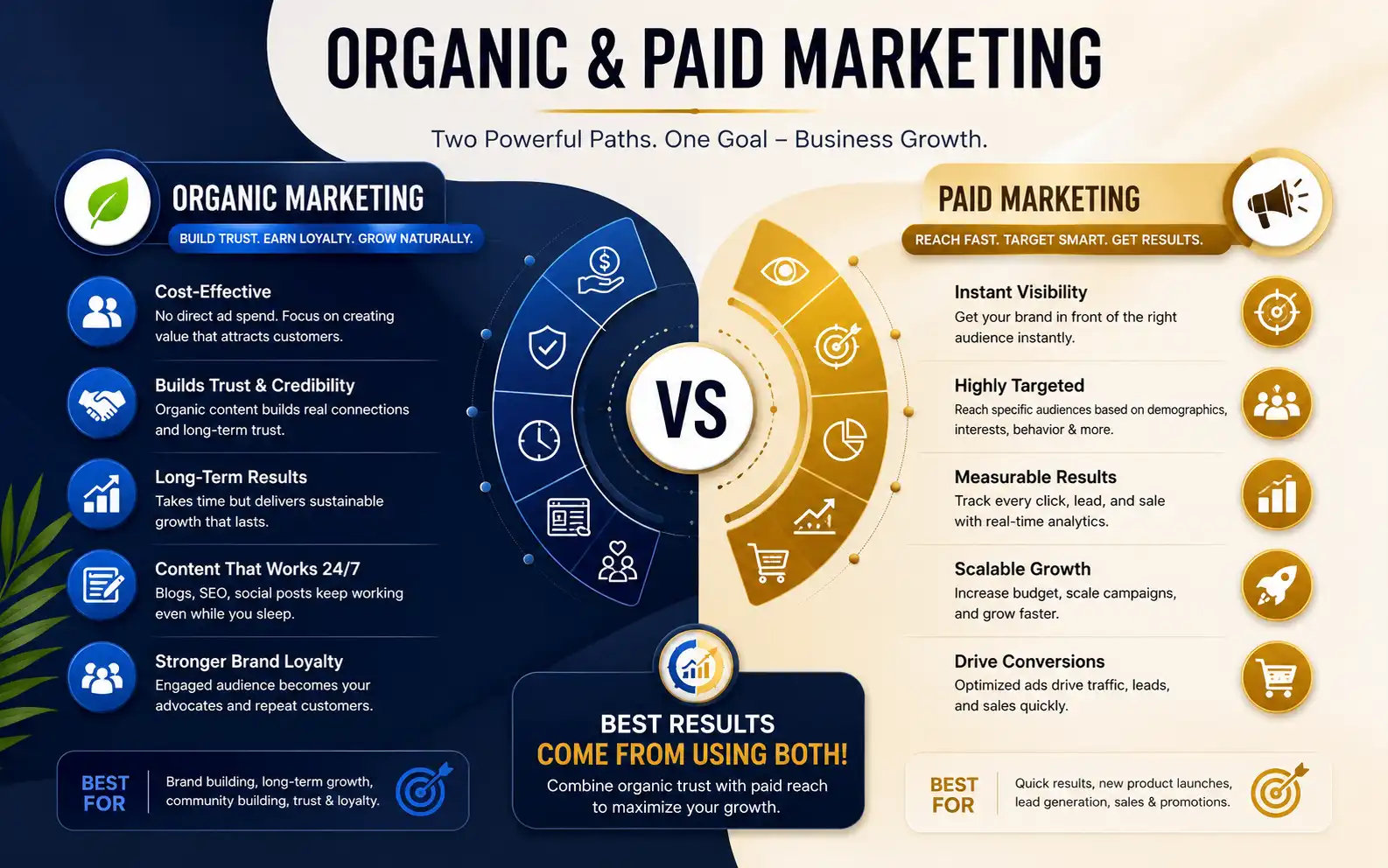
Every business owner asks the same question sooner or later: should I put my time and money into organic marketing or paid marketing? Both can grow your business. Both can also waste your money if you use them the wrong way.
Here is the truth most people miss: organic and paid marketing are not enemies. They are two different tools that do two different jobs — like a hammer and a screwdriver. You don't argue about which is "better." You use the right one for the right job.
In this guide I'll explain both in very simple language, with real examples, so by the end you'll know exactly which one fits your business right now — and how to combine them to grow faster. No jargon. No fluff. Just a clear answer you can act on today.
What is organic marketing?
Organic marketing means getting customers without paying for each click or view. You earn attention instead of buying it.
Here are the most common types of organic marketing:
- SEO — showing up on Google when people search for what you offer.
- Blog posts and helpful content — articles that answer your customers' questions (like this one).
- Your Google Business Profile — the free map listing that shows your business, reviews, hours and photos.
- Social media posts you don't pay to promote.
- Email newsletters sent to people who chose to hear from you.
- Reviews and word of mouth — happy customers bringing you more customers.
- YouTube videos that people find by searching, not by ads.
The key word is earn. When you write a helpful blog, optimise your website, or post something people genuinely love, you build an asset that keeps working for you — often for months or years — without paying again and again.
Organic marketing is like planting a fruit tree. It takes time and care before it gives fruit. But once it grows, it keeps giving — season after season — almost for free.
What is paid marketing?
Paid marketing means paying to put your business in front of people. You buy attention.
The most common types of paid marketing are:
- Google Ads — the "Sponsored" results at the very top of search.
- Facebook and Instagram ads — the promoted posts in people's feeds.
- YouTube ads — the videos that play before the one you wanted.
- Sponsored posts and influencer promotions.
- Display banner ads you see on websites and apps.
The moment you pay, your ad shows. The moment you stop paying, it disappears. With paid marketing, you are renting attention — not owning it.
Paid marketing is like buying fruit at the market. You get it instantly — but you have to pay again every single time you want more.
The real difference, in one line
If you remember nothing else from this article, remember this:
- Organic marketing is slow to start, but builds a lasting asset.
- Paid marketing gives instant results, but stops the moment you stop paying.
That one comparison is the whole debate. Everything else is just detail. Organic is something you own. Paid is something you rent. Both have their place.
The good and the bad of organic marketing
Why people love it
- It builds trust. People trust the businesses that show up naturally on Google far more than the ones with "Ad" next to their name.
- It keeps working. A single blog post or a page that ranks well can bring visitors for years without extra cost.
- The cost per customer drops over time. Once you rank, that traffic is essentially free.
- It compounds. Every piece of content and every link adds to the last, so your results grow bigger over time instead of resetting to zero.
Where it falls short
- It is slow. SEO and content usually take 3 to 6 months — sometimes longer — to show real results.
- It needs consistency. You can't post once and stop. It rewards the patient.
- It needs skill. Good SEO and content require knowledge, research and a clear plan.
Organic marketing is a long game. But it is the strongest foundation any business can build — the day your customers find you for free is the day your business gets truly healthy.
The good and the bad of paid marketing
Why people love it
- It is fast. You can launch an ad today and get enquiries tomorrow.
- It is predictable. Spend a certain amount, get roughly a certain number of clicks. That makes planning easy.
- It is easy to test. You can quickly learn which message, offer or audience works best.
- It's perfect for timing. Launches, festival offers, limited events — anything where you need attention now.
Where it falls short
- It stops when the money stops. No payment means no traffic. Instantly.
- It can get expensive. In competitive markets, a single click can cost a lot.
- People are tired of ads. Many users scroll right past anything that looks promoted.
- It punishes mistakes fast. Without skill, you can burn through a budget with little to show for it.
Paid marketing is a powerful accelerator. Used well, it can transform a business. But never forget — it is rented, not owned.
A simple story to make it click
Imagine you open a brand-new restaurant.
Paid marketing is like putting a giant banner on the highway and paying for it every month. As long as you pay, people see it and walk in. The day you stop paying, the banner comes down and the crowd slowly fades away.
Organic marketing is like becoming famous for the best biriyani in town. It takes time to earn that reputation. But once people know and trust you, they keep coming back — and they bring their friends — without you spending on a banner every month.
Now, here's the lesson: the smartest restaurant owner does both. The banner gets people in fast while the reputation is still being built. The reputation keeps them coming forever. One feeds the other.
How much does each one cost?
This is the question everyone really wants answered, so let's be honest about it.
Paid marketing has an obvious cost: your ad budget. You can start small — even a modest daily amount — and scale up as you see what works. The cost is easy to see, but it never goes to zero. Every customer has a price, and that price can rise as more competitors bid for the same attention.
Organic marketing looks "free," but it isn't really. It costs time and skill instead of ad spend — whether that's your own hours or paying someone to do SEO and content. The big difference is the direction of the cost: with organic, your cost per customer falls over time as your content and rankings build up. With paid, it tends to stay flat or rise.
So the real question isn't "which is cheaper?" It's "do I have more money, or more time and patience, right now?"
So which one should YOU choose?
The honest answer depends on three things: your goal, your budget, and your timeline.
Lean towards paid marketing if:
- You need customers right now — a new business, a sale, or an event.
- You have a budget you can spend consistently each month.
- You want to test an offer or a new product quickly.
- Your market is very competitive and organic will take a long time.
Lean towards organic marketing if:
- You want long-term, lasting growth that doesn't vanish when you stop paying.
- You have more time than money right now.
- You want to build real trust and a recognisable brand.
- You sell things people actively search for on Google.
But here's what I tell almost every business I work with in Kerala and beyond: for most of you, the right answer is not one or the other. It's both — used in the right order.
Why the best results come from combining both
Here is the strategy that actually works, and the one I use with clients:
- 1. Start with paid to get moving. While your organic foundation is still young, paid ads bring in customers and cash flow immediately. This keeps the business healthy through those early months when SEO hasn't kicked in yet.
- 2. Build organic at the same time. Optimise your website, set up your Google Business Profile, and start publishing genuinely helpful content. This is your long-term engine, quietly growing in the background.
- 3. Let paid teach your organic. Ads show you fast which words, offers and audiences actually convert. Take those winning messages and feed them straight into your SEO and content.
- 4. As organic grows, lower your ad spend. Over time, more customers come to you for free through Google and word of mouth. Your cost per customer drops, and your profit rises.
This is the difference between a business that depends on ads forever, and one that slowly becomes unstoppable.
How to start: a simple step-by-step plan
If you're starting from zero, follow this order. Don't skip steps.
- Step 1 — Fix the foundation. Make sure your website is fast, works on mobile, and clearly says what you do. There's no point driving traffic to a broken or confusing page.
- Step 2 — Set up your Google Business Profile. For any local business, this free listing is one of the most powerful things you can do. It puts you on the map — literally.
- Step 3 — Run a small paid campaign. Begin with a small daily budget on Google or Meta to bring in early customers and learn what your audience responds to.
- Step 4 — Publish helpful content. Answer the real questions your customers ask. One genuinely useful article a week beats ten rushed, empty ones.
- Step 5 — Collect reviews. Ask happy customers to leave a review. Reviews boost both trust and your local rankings.
- Step 6 — Measure and adjust. Track what actually brings customers. Do more of what works, and stop what doesn't.
You don't need a huge budget to begin. You need the right order and steady consistency.
Common mistakes to avoid
- Spending everything on ads and ignoring SEO. The day you stop paying, your traffic dies and you're back to zero.
- Expecting SEO to work overnight. It won't. Give it months, not days, and it will reward you.
- Posting random content with no plan. Content without a strategy is just noise that nobody finds.
- Ignoring your website speed. A slow site loses customers and rankings at the same time.
- Not tracking your results. If you don't measure, you're guessing — and guessing is expensive.
- Copying competitors blindly. What works for them may not work for you. Learn from them, but build your own plan.
- Organic marketing is something you own; paid marketing is something you rent.
- Paid gives you speed. Organic gives you staying power.
- The smartest businesses use paid to start fast and organic to grow strong.
- Pick your starting point based on your goal, budget and timeline — then build the other one alongside it.
Which approach fits your type of business?
The right balance changes depending on what kind of business you run. Here's a simple guide for the most common types.
Local shops, restaurants and clinics
Your customers are nearby and they search with intent — "near me," "in Thrissur," "open now." Your biggest organic win is a fully optimised Google Business Profile plus genuine reviews; these can bring in calls and visits for free. Use a small paid budget for launches, festival offers or slow seasons to top up demand. For most local businesses, organic should be the long-term focus, with paid as a booster.
Online stores (e-commerce)
You're often in a fast, competitive market where timing and volume matter. Paid ads (especially shopping ads and retargeting) usually drive sales quickly and let you test products fast. But don't ignore organic — strong product pages, helpful buying guides and SEO bring in free buyers who already trust you, which protects your margins as ad costs rise.
Service businesses and freelancers
People want proof before they hire you. Organic content that shows your expertise — guides, case studies, helpful answers — builds the trust that turns visitors into clients. Paid can fill your pipeline while that reputation grows. Over time, referrals and search should become your main source of work.
New businesses with no audience yet
When nobody knows you exist, organic alone feels painfully slow. This is exactly when paid earns its place — it buys you visibility and your first customers immediately, while you quietly build the organic foundation that will carry you later. Start paid, build organic, then shift the balance.
A quick myth-buster
Before we finish, let's clear up three things people get wrong all the time.
- "SEO is dead." It isn't. The way people search keeps changing, but the need to be found when someone is looking for you never goes away. SEO simply evolves.
- "Ads will fix a bad business." They won't. Paid traffic to a confusing website or a weak offer just helps you lose money faster. Fix the foundation first.
- "More traffic always means more sales." Not true. The right traffic matters far more than a lot of traffic. Ten ready-to-buy visitors beat a thousand who landed by accident.
Final thoughts
Organic marketing and paid marketing were never rivals — they're partners. Paid gives you speed when you need customers now. Organic gives you the trust and the lasting reach that keep customers coming long after the ads are switched off.
The businesses that truly win don't pick a side. They use paid to start fast and organic to grow strong — until one day, customers find them without any ad at all. That's the goal: a business that markets itself.
If you're not sure where your business should focus its time and budget right now, that's exactly the kind of thing I help Kerala brands figure out — with a clear plan, not guesswork.

Not sure where to start?
Tell me about your business and I'll help you figure out the right mix of organic and paid — built around your goals, not guesswork.
Work with me → ← Back to all articles