Technical SEO Made Simple for Small Business Websites
You can have the best products in Thrissur and the smartest marketing in Kerala — and still lose to a worse competitor on Google. Why? Their site is technically easier for Google to read and rank. That's what technical SEO fixes, and it's often the difference between a business that gets found and one that doesn't.
In plain language: technical SEO is the work of making your website friendly to Google, not to humans. Content is for humans. Design is for your visitors. Technical SEO is for the robot deciding whether you land on page one or page ten, where almost nobody scrolls.
What technical SEO actually covers
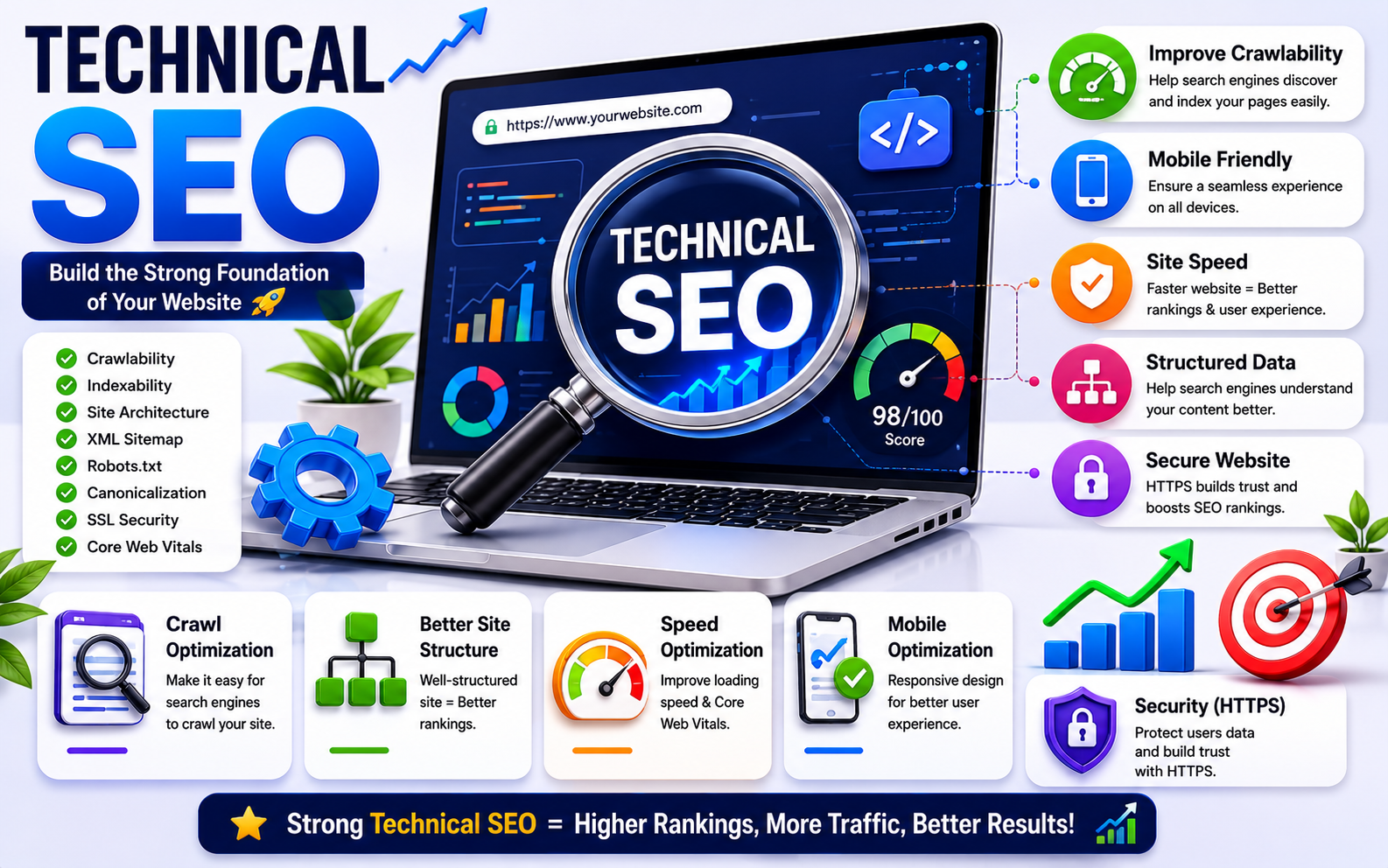
Imagine a shop with the door hidden behind boxes and every shelf labelled in a language nobody reads. Customers won't find what you sell, no matter how good the products are. Technical SEO fixes exactly that problem, but for search engines. It makes sure Google can find every page on your site, understand what each one is actually about, save it into its index, and trust that your site is fast, safe, and worth showing to searchers.
Miss any one of those four things and your rankings break with it, no matter how good your content or design happens to be.
Pillar one: speed
Speed is measured through something called Core Web Vitals — essentially, how fast your main content appears on screen, how quickly the page responds when someone taps a button, and whether elements jump around unexpectedly while the page is still loading. You can test your own site for free using Google's PageSpeed Insights tool. The most common culprits behind a slow site are huge, uncompressed images uploaded straight from a phone, too many plugins doing overlapping jobs, and cheap shared hosting that struggles the moment real traffic shows up.
Pillar two: mobile-friendliness
Most of your visitors are browsing on a phone, and Google actually ranks your site based on how it performs there, not on desktop. Open your own site on your own phone right now and try to use it like a stranger would. If the text is too small to read comfortably, buttons feel cramped together, or anything loads slowly, Google notices exactly what you just noticed — and so does every customer who gives up and leaves.
Pillar three: crawlability and indexing
Googlebot needs to physically reach a page before it can ever consider ranking it. A clean sitemap and a correctly configured robots.txt file are what guide it there safely. Get robots.txt wrong, even by a single misplaced line, and you can accidentally hide your entire website from Google without ever realising it happened.
Crawling simply gets your page visited. Indexing is a separate decision — whether Google actually keeps that page in the library it shows to searchers. You could have 150 pages on your site and only 60 sitting in the index, and never know unless you check. Google Search Console's "Pages" report shows you exactly which pages made it in and why the rest were left out — usually thin content, an accidental noindex tag, or pages Google sees as duplicates of each other.
Pillar four: site structure
A website with no clear structure behaves like a city with no street signs — visitors and search engines alike get lost. The strongest layout to aim for is hub-and-spoke: your homepage links out to main categories like services and blog, and each of those category pages links further down to the specific pages beneath it. A simple rule worth following religiously — every important page on your site should be reachable within three clicks of your homepage. Beyond that, neither Google's crawler nor a real visitor will bother finding it.
Trust signals that quietly matter
HTTPS is non-negotiable in 2026 — a site without that padlock looks outdated and untrustworthy to both Google and visitors alike. Clean URLs built from real words, like capareach.com/local-seo-thrissur, are trusted far more than long strings of random numbers and parameters. And schema markup, a small piece of code that describes exactly what your page is, is what unlocks star ratings and rich results in search — pulling in more clicks even without changing your actual ranking position at all.
The mistakes almost every small business site makes
Check nearly any small Kerala business website right now and you'll likely spot at least three of these: uncompressed images slowing everything down, an accidentally misconfigured robots.txt file, missing HTTPS, zero mobile testing before launch, orphan pages that nothing else links to, or a broken and forgotten sitemap. Every single one of these is genuinely fixable in a matter of hours once you know exactly where to look.
A free 20-minute audit you can run today
- Run your homepage through PageSpeed Insights and note what it flags.
- Open Search Console and check your "Pages" report for anything excluded.
- Test your site on Google's Mobile-Friendly Test tool.
- Open your own site on your own phone and genuinely try to use it as a first-time visitor would.
- Check whether your URL bar shows https:// with a padlock icon.
- Search Google for site:yourdomain.com and compare the results to how many pages you actually think exist.
If anything looks even slightly off, you now have your first prioritised technical SEO to-do list, and it didn't cost you a single rupee to find it.
The foundation everything else sits on
Great content, sharp design, and clever marketing campaigns all sit on top of technical SEO, whether anyone realises it or not. If that foundation cracks, nothing built above it holds up for very long. Start with the highest-impact fixes first — speed, mobile experience, and indexing — then work steadily down the list from there. Each fix compounds on the last, and within a few months you'll have a site that Google genuinely trusts to rank well.
If you'd like a proper, prioritised audit of your own website, that's exactly the work I do every day for businesses across Thrissur and the wider Kerala market.

Want a proper technical SEO audit?
Get a forensic, prioritised, plain-English report on exactly what's holding your website back — and how to fix it in order of impact.
Work with me → ← Back to all articles